
A woman sat down at her computer and typed “cinnamon coloured skirt with elastic waist and pockets” into Google.
One of my clients came up first. With exactly that. She picked up the phone and bought it.

Nobody paid an agency for that. No monthly retainer, no audit, no strategy deck. Somebody just wrote a product title that described the actual product in the words a real person would use.
That is the whole game. And the hardest part is not the writing. It is working out which words to use, because after years in your industry you have completely lost the ability to describe your own products the way a stranger would.
So here are six ways to find out, all free, all using things you already have.
First, why plain words beat clever ones
There is a version of you that wants your product to be called Rose. It is prettier. It suits the brand. It photographs beautifully on a swing tag.
And then there is your customer, who is typing “baby pink” into Google at 10pm.
I worked with a brand whose entire new range was named after colours like that. Beautiful names. Genuinely lovely. And almost nobody could find any of it, because the words on the website and the words in the search bar had nothing in common.
You do not have to choose. Call it Rose in your branding and put baby pink in the title, the description and the tags. Google reads all of it. Your customer only needs to match one.
The short tail problem

Short tail keywords are the obvious one or two word ones. Dress. Candle. Hamper.
They have enormous search volume, which is exactly why you will never win them. You are competing against businesses with SEO budgets bigger than your annual turnover. You could do everything right for two years and still be on page eleven.
Long tail keywords are the specific ones. “Silk slip dress with adjustable straps Australia.” “Soy candle that smells like a bookshop.” “Cinnamon coloured skirt with elastic waist and pockets.”
Fewer people search them. Far fewer. And that is the point, because the handful who do are describing exactly what you sell, and they are much closer to their credit card than the person typing “dress”.
Low volume, high intent, actually winnable. That is the trade you want.
Six ways to find yours
1. Google’s autocomplete is a free research tool
Open an incognito window so your own history does not skew things. Start typing what you sell and stop.
“Australian made table linen…”
Google will finish the sentence for you, and every suggestion it offers is a phrase real people are typing often enough for Google to have noticed. That is search volume data, handed to you, at no cost.
Do it with your product category. Do it with your category plus a colour. Your category plus a city. Your category plus “for”. “Gift for a new mum who…” will show you things about your own market you did not know.
Write down everything that surprises you.
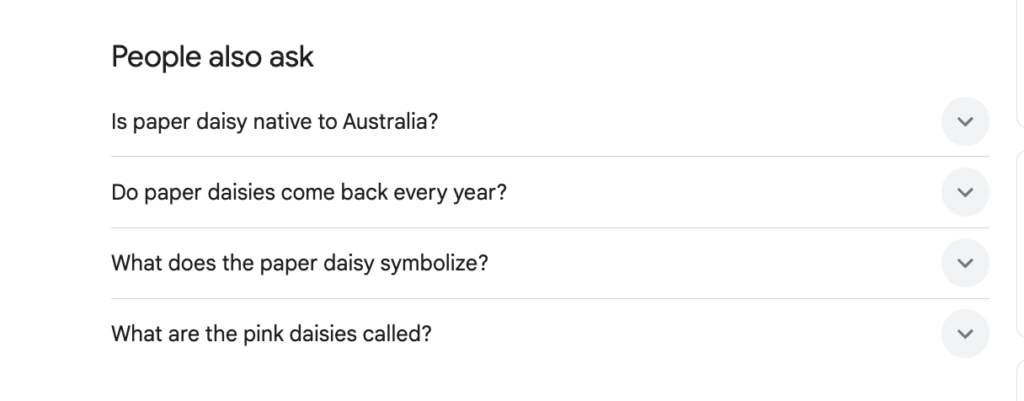
2. The “People also ask” box
Search your category and scroll down. That box of questions is not decoration. It is a list of what your customers are confused about, curious about, or trying to decide.
“How do I stop my linen tablecloth wrinkling?” “What is the difference between a maxi and a midi?” “How long do soy candles last?”
Every one of those is a blog post, an FAQ entry, or a line in a product description that answers the question before she has to email you and ask. Click one open and it spawns more. You can fill a year of content in fifteen minutes.
3. Search Console: the actual answer
Everything above is educated guessing. This one is data.
Google Search Console is free, it takes ten minutes to connect, and it shows you the exact phrases people typed to find your website. Not what they might search. What they did search.
Connect it, wait a fortnight, then open Performance and click Queries. You will find words you would never have chosen and phrases you have been avoiding because they sounded too obvious.
Sort by position and look for anything sitting between eleven and twenty. That is page two, which means Google already thinks you are relevant and you are simply not visible yet. Optimise that page properly for that phrase and you have found your highest return hour of work this month.
If you do one thing off this whole list, do this one.
4. Read your own inbox
Your customers have been telling you their keywords for years. You just filed the emails.
Go and read your DMs, your customer service emails, your product reviews, your market stall conversations if you sell in person. Not for the compliments. For the nouns.
What do they call it? What do they compare it to? What do they say when they are trying to describe the thing they want but do not know your product name?
“Do you have that skirt with the pockets?” is a keyword. “Something for my mum who is impossible to buy for” is a keyword. “The one that does not feel plasticky” is a keyword, and it is worth more than anything a tool will give you, because it comes with the emotion attached.
5. Look at whoever is beating you
Search the term you want to own and look at who comes up. Then read their page title and the grey text underneath it in the results. That is their meta title and meta description, and it is a public statement of what they are targeting.
You are not copying. You are learning which words they decided were worth the space, and spotting the gap they left. If four of them all say “linen” and none of them say “Australian made”, and you are Australian made, you have just found your angle.
6. Search where people shop, not just where they Google
Type your product into Pinterest, Etsy, eBay and Amazon and watch what their search bars suggest.
These are people in buying mode, not browsing mode, and the language is different. Pinterest in particular is a goldmine for how people describe aesthetics, occasions and rooms. “Coastal grandmother kitchen” is not a phrase any keyword tool would have handed you, and yet.
Now turn the list into something useful
You should have a messy page of phrases. Sort them into three piles.
Your core terms. The plain, obvious words for what you sell. These go in your product titles, your homepage meta title, your main collection names. Boring, essential, non-negotiable. If you sell candles, the word candle needs to appear on your website more than you think it does.
Your long tail terms. The specific descriptive phrases. These go in product descriptions, image alt text, and the extra collections you build purely to be found. One phrase per page. Do not try to make one product rank for nine things.
Your questions. Everything from the People also ask box and your inbox. These become blog posts, FAQ entries, and the paragraph in your product description that answers the thing before it becomes a return.
Two rules before you start typing
Write for the person, not the algorithm. If you read your description out loud and it sounds like a robot stacking words, Google thinks so too. Keyword stuffing has not worked for years and it makes people leave, which is its own ranking signal.
One phrase per page. A product page that half-heartedly targets six keywords will rank for none of them. One clear phrase, used naturally in the title, the description, the meta description and the alt text, beats a scattergun every time.
Where to actually put them
Finding the words is half of it. The other half is knowing the six places on every product listing that are quietly sitting empty, and the collection pages that are almost certainly the biggest wasted opportunity on your entire website.
That is what the SEO Boosters Masterclass walks through, step by step, in the exact order you would do it while uploading a product.
Start with Search Console though. Connect it today, and in two weeks you will have a list of keywords nobody had to guess at.

Comments +